


Blog
Receiving Freight: Docks, Forklifts and Liftgate Service Explained

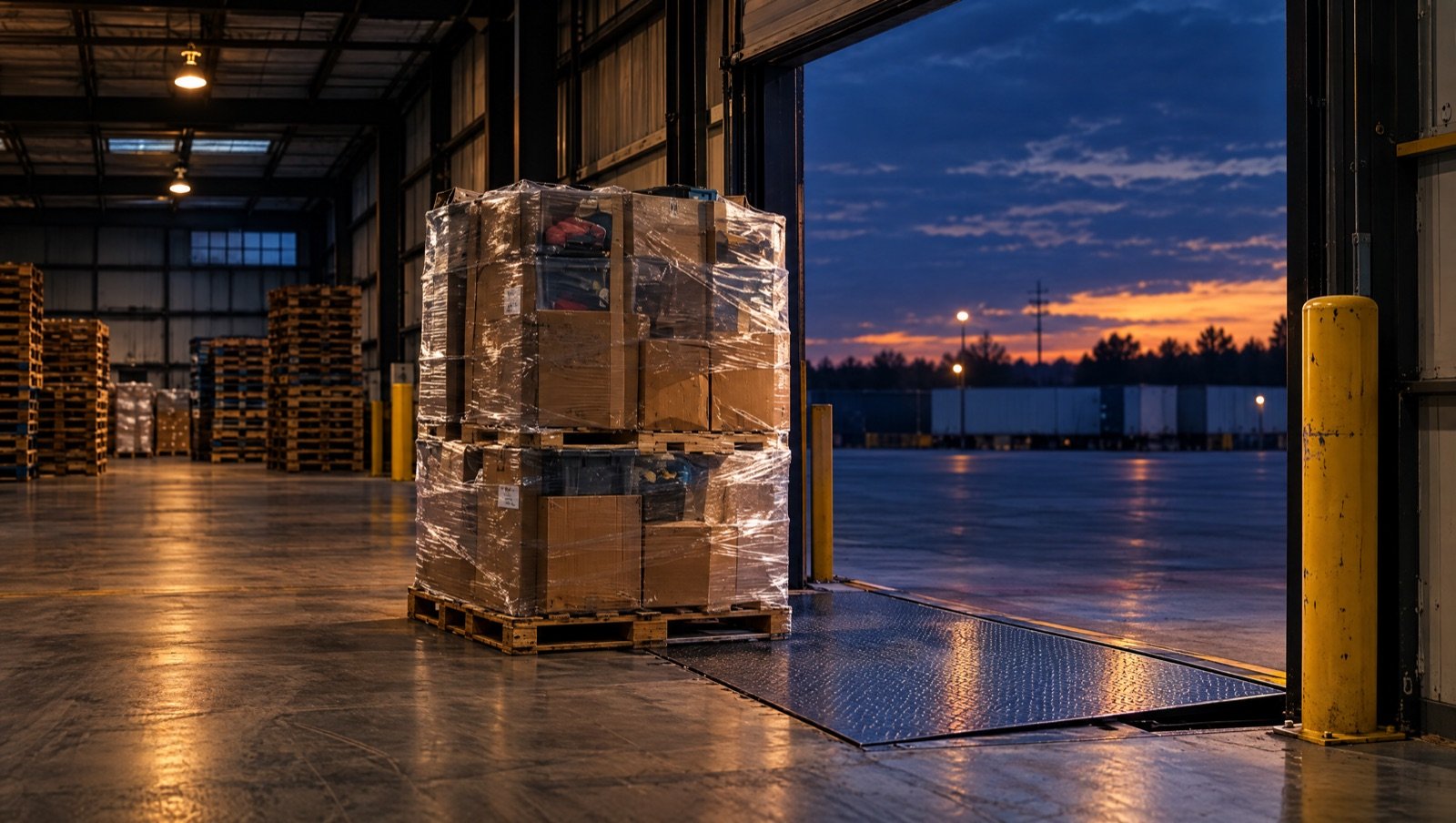
Most of the avoidable trouble in liquidation buying happens in the twenty minutes the truck is parked outside. The merchandise is usually fine. The receiving is what catches people out.
This guide covers what actually happens at delivery, what equipment you need, how liftgate service works, and how to document a problem so a claim stays open to you.
Freight is not a parcel
A liquidation pallet does not arrive in a van. It comes on a freight trailer, often weighs several hundred pounds, and the driver is not required to bring it inside or break it down for you. Unloading is the receiver responsibility unless additional services have been arranged in advance.
That single fact explains most delivery disputes. Plan for it and the rest is straightforward.
The three ways to get a pallet off a truck
A loading dock
The simplest option. The trailer backs up, a dock plate bridges the gap, and the pallet rolls straight off with a pallet jack. If you have a dock, tell us and there is nothing further to arrange.
A forklift
Also straightforward, provided the forklift has the capacity for the load and someone qualified to operate it. Confirm the rated capacity against the weight of the lot rather than assuming.
Liftgate service
If you have neither a dock nor a forklift, a liftgate may be available. A liftgate is a powered platform on the back of the truck that lowers the pallet from trailer height to ground level. It makes curbside delivery possible at addresses that could not otherwise receive freight.
Two things worth knowing. Liftgate service is arranged in advance, not selected at the last minute, so tell us before your order ships. And a liftgate puts the pallet on the ground at the kerb, which is not the same as putting it inside your building. Moving it from there is still on you, and a loaded pallet is not something to bring down by hand.
Before the truck arrives
- Confirm the delivery address can physically take a freight trailer. Tight residential streets, low branches and steep driveways are real constraints.
- Have the unloading method settled and, if it is a liftgate, arranged with us beforehand.
- Make sure someone will be there who is authorised to inspect and sign.
- Clear the space where the pallet is going to land.
At delivery: inspect before you sign
This is the part that matters most, and it takes two minutes.
Look at the shipment before you sign the Bill of Lading. You are checking for obvious transit damage: crushed cartons, torn stretch film, a leaning or collapsed stack, water staining, a pallet that has clearly been dropped. Photograph the packaging and the goods while everything is still as delivered.
If anything looks wrong, write it on the Bill of Lading before you sign. A clean signature tells the carrier the freight arrived in good order. Once that is on record, the carrier may no longer be responsible and a freight claim may not be available to anyone, including us.
Then contact us within 48 hours with the photographs and your order details so we can act while the claim window is open.
After delivery: the other claims
Transit damage is time critical because a carrier is involved. Other issues have a longer window. For a wrong lot, a condition that is materially different from what the listing represented, a non-functional delivery beyond what was disclosed, or a shortage of handling units, contact us within 30 days of delivery.
What is not covered is worth stating plainly: change of mind, normal wear, disclosed missing parts or cosmetic flaws, and the ordinary condition variation inherent in liquidation stock. Our Refund and Returns Policy sets out both sides in full.
Timing
Orders are processed in one to two business days after cleared payment, with transit typically running one to seven business days depending on distance. Free freight applies to orders in all 50 states, and free shipping does not guarantee a specific delivery date. Our Shipping Policy has the detail.
The short version
Decide how the pallet is coming off the truck before you order. Inspect before you sign. Note any damage on the Bill of Lading. Photograph everything. Tell us inside 48 hours for transit damage, 30 days for anything else.
If you are not sure what your address can take, send us your ZIP code and we will confirm what is workable before you commit.